Adventurefy
Adventurefy


Overview
Timeline
Timeline
Feb 2024 - Sept 2024
Feb 2024 - Sept 2024
Role
Role
UI/UX Designer
UI/UX Designer
Team
Team
2 PM
6 Developers
2 Designers
2 Animator
2 PM
6 Developers
2 Designers
2 Animator
Tools
Tools
Figma
Procreate
Figma
Procreate
Adventurefy is an LLC-established startup based in Dallas, Texas, dedicated to making productivity enjoyable through gamification. Adventurefy’s mission is to promote productivity in a way that is unobtrusive, avoids self-comparison and burnout, and fosters a positive relationship with productivity by rewarding task completion within a role-playing game.
For this case study, I was tasked with designing a gamified RPG by researching the leading reasons of reduced productivity in the app market. I leveraged my UI design skills and aesthetics to create a fun, engaging, and successful launch. Through gamification, our goal was to ease users into a familiar yet entertaining environment with productive twists.
00 EMPATHIZE
Did you know only 8% of people reach their goals?
According to Forbes, only 8% of people achieve their goals, particularly those related to their careers, mental health, physical fitness, and organizational habits. For the remaining 92%, the failure to reach their goals can lead to feelings of anxiety, depression, and hopelessness. These negative impacts on mental health contribute to the rising suicide epidemic, which remains one of the leading causes of death in the United States.
As college students, our team deeply empathized with this statistic. Balancing social life, the freedom of youth, and the demands of preparing for adulthood is challenging, often leading to burnout. This challenge inspired us to create a gamified product designed to combat these issues:
HOW CAN WE...
Enhance productivity and build consistent habits for achieving goals?
Enhance productivity and build consistent habits for achieving goals?
00 EMPATHIZE
Why Gamification? Apps are increasingly being gamified.
Instead of creating a typical productivity app that is straightforward and minimalistic, our team was committed to the concept of gamification from the start. Here’s why:
Instead of creating a typical productivity app that is straightforward and minimalistic, our team was committed to the concept of gamification from the start. Here’s why:
OVER 70% OF COMPANIES ARE LISTED AMONG THE TOP 2000 GLOBAL COMPANIES TO IMPLEMENT GAMIFICATION
Gamification is already a currently trending marketing, and it is still growing! A report by MarketsandMarkets projected that the global gamification market would grow from $9.1 billion in 2020 to $30.7 billion by 2025, at a CAGR (Compound Annual Growth Rate) of 27.4%. This rapid growth indicates that more companies are adopting gamification strategies across various sectors. If top companies are adopting these strategies, then there has to be a reason.
Gamification is already a currently trending marketing, and it is still growing! A report by MarketsandMarkets projected that the global gamification market would grow from $9.1 billion in 2020 to $30.7 billion by 2025, at a CAGR (Compound Annual Growth Rate) of 27.4%. This rapid growth indicates that more companies are adopting gamification strategies across various sectors. If top companies are adopting these strategies, then there has to be a reason.
PRODUCTIVITY APPS FOCUSED ON HABIT TRACKING AND GROWTH OFTEN INCORPORATE GAMIFICATION
Like any strategy, gamification may not work for everything and is often considered overrated. However, the most popular apps that utilize gamified features are often designed to build skills.
Like any strategy, gamification may not work for everything and is often considered overrated. However, the most popular apps that utilize gamified features are often designed to build skills.

GAMIFICATION INTRODUCES A RANGE OF FEATURES NOT COMMONLY FOUND IN MANY OTHER APPS
Having been a designer for over a year, I've noticed that many productivity apps rely on similar design systems, typically featuring mundane to-do lists, calendars, and notes sections. Over the past 8 months, our team tested whether gamification can be applied to comprehensive productivity solutions.
Having been a designer for over a year, I've noticed that many productivity apps rely on similar design systems, typically featuring mundane to-do lists, calendars, and notes sections. Over the past 8 months, our team tested whether gamification can be applied to comprehensive productivity solutions.
OUR CHALLENGE:
Make staying on track with goals fun and easy through engaging, gamified role-playing adventures.
Make staying on track with goals fun and easy through engaging, gamified role-playing adventures.
01 USER RESEARCH
Our Research Pipeline


Secondary Research
Conducted competitive analysis on the top grossing productivity apps in the market.

Online Survey
Gathered insights from 80+ individuals ranging from 10-65 years of age

Usability Testing
Observed 3 individuals use our top competitor, Habitica, consistently for a week.
01 COMPETITIVE ANALYSIS
What is wrong with current productivity apps?
Before surveying users, I wanted to see what is currently on the productivity app market. What’s working? What is not? Streaming through Reddit threads, Apple Store reviews, and overall social media, I looked for reviews on top-grossing apps in this sector. Our team conducted a brief competition analysis to see what demands each app meets.
Before surveying users, I wanted to see what is currently on the productivity app market. What’s working? What is not? Streaming through Reddit threads, Apple Store reviews, and overall social media, I looked for reviews on top-grossing apps in this sector. Our team conducted a brief competition analysis to see what demands each app meets.

01 OBSERVATIONAL USABILITY TEST
We identified gaps in our biggest competitor, Habitica, through week-long usability tests
Unfortunately, we are not the first company to develop a gamified, RPG-based productivity app. Habitica, founded in 2013, is nearly 11 years old and has a user base of over 4 million. While this sounds impressive on paper, it pales in comparison to top-grossing productivity apps like Notion (35+ million users), Todoist (30+ million users), and TickTick (20+ million users). With our gamified app, we aim to achieve the same level of success as these leading productivity platforms.
Although we had already conducted a competitive analysis of Habitica, we sought a more authentic approach by conducting usability testing, where three individuals used Habitica for one week. This allowed us to track errors in Habitica’s user journey and uncover specific insights not available from Reddit threads, articles, or social media. This approach helped us determine whether the gamified RPG aspect wasn’t working or if it was simply not being implemented effectively in Habitica. We summarized users' thoughts and consolidated them into a user journey.

02 DEFINE / PAIN POINTS
Organizing our findings through affinity mapping
Our data came in a wide range due to the variety of research methods we employed. At first, our team considered analyzing the data separately, aligning it with the specific research methods used. However, we realized that this approach wouldn’t provide the overarching insights we were seeking. To better organize and synthesize our findings, we turned to affinity mapping. Through this process, we identified a central pain point: users find productivity apps boring. After further analysis and following-up with users, we concluded that the app's unsustainable nature is driven by four factors: insufficient user discipline, a lack of user motivation, complicated workflows, and a variety of limitations.
Our data came in a wide range due to the variety of research methods we employed. At first, our team considered analyzing the data separately, aligning it with the specific research methods used. However, we realized that this approach wouldn’t provide the overarching insights we were seeking. To better organize and synthesize our findings, we turned to affinity mapping. Through this process, we identified a central pain point: users find productivity apps boring. After further analysis and following-up with users, we concluded that the app's unsustainable nature is driven by four factors: insufficient user discipline, a lack of user motivation, complicated workflows, and a variety of limitations.

HOW DOES THIS IMPACT THE TEAM?
Why productivity apps being boring is both good and bad news
Did you know that word “bored” was mentioned over 82 times across all our research methods? Naturally, this did not surprise our team, as it is in our human nature to get bored easily in situations lacking stimulation or interest. However, this presented a dilemma. Making our app less boring is challenging because ‘boring' is subjective. A user's definition of boring could be influenced by all four factors or just one, so we need to ensure that various pain points are creatively addressed in our gameplay for optimal effectiveness. While this brought the team extra pressure to ensure this app is the most entertaining it can be, it reaffirms the decision that gamification was the optimal strategy to use in our problem space, and here’s why:
Did you know that word “bored” was mentioned over 82 times across all our research methods? Naturally, this did not surprise our team, as it is in our human nature to get bored easily in situations lacking stimulation or interest. However, this presented a dilemma. Making our app less boring is challenging because ‘boring' is subjective. A user's definition of boring could be influenced by all four factors or just one, so we need to ensure that various pain points are creatively addressed in our gameplay for optimal effectiveness. While this brought the team extra pressure to ensure this app is the most entertaining it can be, it reaffirms the decision that gamification was the optimal strategy to use in our problem space, and here’s why:
WHEN YOUR WORK BECOMES FUN, THE PRODUCTION WILL TAKE CARE OF ITSELF
WHEN YOUR WORK BECOMES FUN, THE PRODUCTION WILL TAKE CARE OF ITSELF
-ALI ABDAAL
-ALI ABDAAL
Reassurance: the best way to make a game fun is through gamification
Unlike other strategies, gamification is the best way to turn strict environments into fun ones as it allows the most room to for features that have a higher chance of positive emotions. Here are examples of how gamification will help in the scenario of boredom:
Unlike other strategies, gamification is the best way to turn strict environments into fun ones as it allows the most room to for features that have a higher chance of positive emotions. Here are examples of how gamification will help in the scenario of boredom:

UNIQUE ENGAGEMENT
UNIQUE ENGAGEMENT
Gamification introduces points, levels, and rewards, making tasks more engaging and enjoyable, encouraging users to interact with the app more frequently.
Gamification introduces points, levels, and rewards, making tasks more engaging and enjoyable, encouraging users to interact with the app more frequently.

FOSTERING COMPETITION
FOSTERING COMPETITION
Many gamified apps include social features like leaderboards, challenges, and multiplayer elements, adding competition and community, making the experience more enjoyable.
Many gamified apps include social features like leaderboards, challenges, and multiplayer elements, adding competition and community, making the experience more enjoyable.

AWAKENED CURIOSITY
AWAKENED CURIOSITY
Unfamiliar yet exciting game environments evoke curiosity, motivating users to progress, earn rewards, and enjoy a continuous stream of adventurous experiences.
Unfamiliar yet exciting game environments evoke curiosity, motivating users to progress, earn rewards, and enjoy a continuous stream of adventurous experiences.

VARIETY AND CREATIVITY
VARIETY AND CREATIVITY
Gamification allows for creative approaches to problem-solving and task completion, making the experience more dynamic and less monotonous compared to traditional methods.
Gamification allows for creative approaches to problem-solving and task completion, making the experience more dynamic and less monotonous compared to traditional methods.
Next: What should we focus on?
Our team listed points to keep in mind while devising solutions to address users’ pain points.

Entertainment
What is our journey to keep users engaged and not bored?

Discipline
How will we keep users disciplined to be productive?

Call-to-Action
How can we make users excited to complete tasks?

Workflow
How can we ease
users into a productive workspace?
Flexibility
What features can we add to make users feel unrestricted?
02 SOLVE
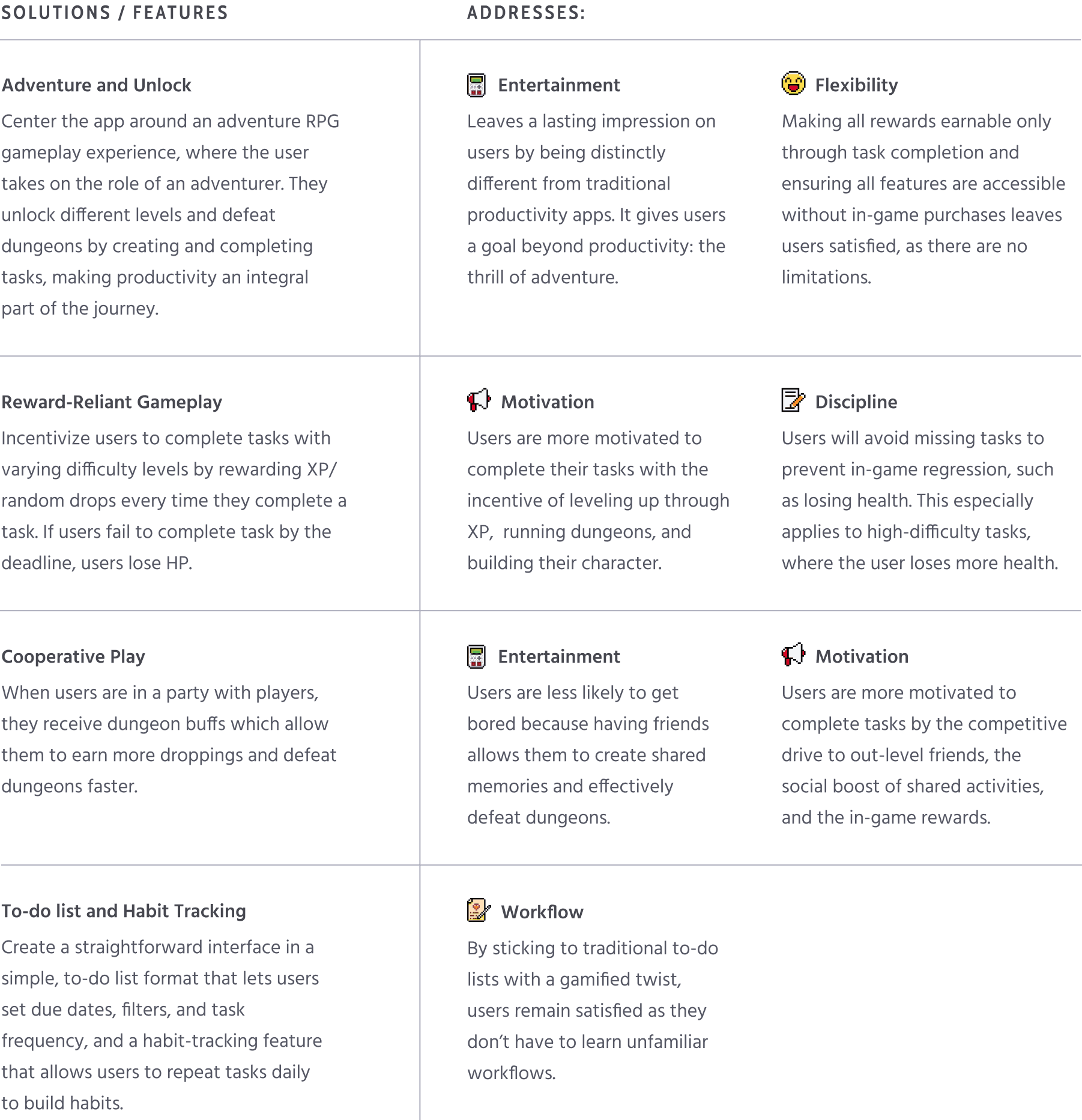
After days of brainstorming, we solidified four solutions:
SOLUTIONS / FEATURES
ADDRESSES:
Flexibility
Making all rewards earnable only through task completion and ensuring all features are accessible without in-game purchases leaves users satisfied, as there are no limitations.
Entertainment

Leaves a lasting impression on users by being distinctly different from traditional productivity apps. It gives users a goal beyond productivity: the thrill of adventure.
Adventure and Unlock
Center the app around an adventure RPG gameplay experience, where the user takes on the role of an adventurer. They unlock different levels and defeat dungeons by creating and completing tasks, making productivity an integral part of the journey.
Discipline
Users will avoid missing tasks to prevent in-game regression, such as losing health. This especially applies to high-difficulty tasks, where the user loses more health.
Motivation
Users are more motivated to complete their tasks with the incentive of leveling up through XP, running dungeons, and building their character.
Reward-Reliant Gameplay
Incentivize users to complete tasks with varying difficulty levels by rewarding XP/random drops every time they complete a task. If users fail to complete task by the deadline, users lose HP.
Motivation
Users are more motivated to complete tasks by the competitive drive to out-level friends, the social boost of shared activities, and the in-game rewards.
Cooperative Play
When users are in a party with players, they receive dungeon buffs which allow them to earn more droppings and defeat dungeons faster.
Entertainment
Users are less likely to get bored because having friends allows them to create shared memories and effectively defeat dungeons.
To-do list and Habit Tracking
Create a straightforward interface in a simple, to-do list format that lets users set due dates, filters, and task frequency, and a habit-tracking feature that allows users to repeat tasks daily to build habits.
Workflow
By sticking to traditional to-do lists with a gamified twist, users remain satisfied as they don’t have to learn unfamiliar workflows.
03 USER FLOWS
Roleplay games are complicated, so we established a user flow.
Since our product combines a productivity app with an RPG, we needed to create many more wireframes and screens to ensure it functioned cohesively as an RPG. Unlike typical productivity apps, there are several additions we need to keep in mind when designing our wireframes. Diagramming user flows helped guide our direction and reinforced our decisions on where to structure certain screens.
Since our product combines a productivity app with an RPG, we needed to create many more wireframes and screens to ensure it functioned cohesively as an RPG. Unlike typical productivity apps, there are several additions we need to keep in mind when designing our wireframes. Diagramming user flows helped guide our direction and reinforced our decisions on where to structure certain screens.

03 DESIGN
Our dilemma: Is this a productivity app or a game?
When we reached the low-fidelity stage, our team was conflicted about which screen orientation to choose: vertical or horizontal. Most productivity apps traditionally use a vertical orientation to create an optimal space for users to easily access pages. In contrast, most games, especially RPGs, typically use a horizontal orientation, making it easier for users to engage in combat and simulating the feeling of holding a game controller.
When we reached the low-fidelity stage, our team was conflicted about which screen orientation to choose: vertical or horizontal. Most productivity apps traditionally use a vertical orientation to create an optimal space for users to easily access pages. In contrast, most games, especially RPGs, typically use a horizontal orientation, making it easier for users to engage in combat and simulating the feeling of holding a game controller.


I began by sketching sample wireframes to compare the two orientations and see which best fit our projected user flow. While our app has a heavy gamification integration, our mission is to make productivity fun and help users become productive immediately. Because of this, the team decided that a vertical screen was the better choice for our mobile app. A vertical screen promotes convenient navigation, allowing users to easily switch between different apps while staying productive, and aligns with the current expectations for productivity apps. Breaking this convention could be counterproductive. Choosing a horizontal screen might lead users to associate the app more with gaming, which could result in higher expectations for gameplay, potential distractions, and unmet expectations compared to traditional gaming apps. Ultimately, the vertical interface made more sense from the user's perspective.
I began by sketching sample wireframes to compare the two orientations and see which best fit our projected user flow. While our app has a heavy gamification integration, our mission is to make productivity fun and help users become productive immediately. Because of this, the team decided that a vertical screen was the better choice for our mobile app. A vertical screen promotes convenient navigation, allowing users to easily switch between different apps while staying productive, and aligns with the current expectations for productivity apps. Breaking this convention could be counterproductive. Choosing a horizontal screen might lead users to associate the app more with gaming, which could result in higher expectations for gameplay, potential distractions, and unmet expectations compared to traditional gaming apps. Ultimately, the vertical interface made more sense from the user's perspective.


03 STYLE GUIDE
Bringing adventure to life

USABILITY TEST
Overvaluing simplicity and undervaluing customization
A major flaw in our usability test was that the system of organization felt outdated. Initially, the team aimed to avoid overcomplicating the inventory view to 1. prevent users from becoming too immersed in the game aspect of our product and 2. avoid confusing inexperienced RPG users with complicated game layouts. However, this approach ended up being inconvenient for users. To address this, we switched to a more efficient inventory system with a grid layout, search navigation, and overlays of item descriptions.
A major flaw in our usability test was that the system of organization felt outdated. Initially, the team aimed to avoid overcomplicating the inventory view to 1. prevent users from becoming too immersed in the game aspect of our product and 2. avoid confusing inexperienced RPG users with complicated game layouts. However, this approach ended up being inconvenient for users. To address this, we switched to a more efficient inventory system with a grid layout, search navigation, and overlays of item descriptions.

BEFORE
The UI is dull and bland. The backpack button lacks a signifier, making it unclear that it’s clickable. Inventory items can be easily mistaken for others due to the lack of descriptions and signifiers. Additionally, it’s cumbersome for users to equip items, switch between item types, and freely scroll through their inventory.
The UI is dull and bland. The backpack button lacks a signifier, making it unclear that it’s clickable. Inventory items can be easily mistaken for others due to the lack of descriptions and signifiers. Additionally, it’s cumbersome for users to equip items, switch between item types, and freely scroll through their inventory.


AFTER
The UI is more colorful, allowing users to easily identify items by category based on color. Additionally, instead of meticulously scrolling through the inventory, it expands to a grid format, enabling users to view multiple items at once and easily access their descriptions before equipping them.
Are people familiarized with RPGs in the productivity space: Our team initially worried that a grid system might be too complex for RPG newcomers. However, we found that a grid system would be more practical. This is because relying on recognition rather than recall and leveraging familiarity with real-world systems make it easier for users. Even if users are not RPG experts, they are likely familiar with inventory pages, as this is a common feature in many apps.


FINAL DESIGNS
The Adventure Begins Here. Meet Adventurefy!
Rewards aren't the only motivator: Outplay your friends, prove who's the most competitive, and score in-party buffs!
Rewards aren't the only motivator: Outplay your friends, prove who's the most competitive, and score in-party buffs!
Adventurefy offers cooperative play where users team up with friends to conquer dungeons, earn party buffs, unleash special combos, and enjoy a blend of adventure and productivity in a group setting.
The hierarchy of Team, Skills, Items, and Flee is ranked by importance, with 'Team' as the default option in the in-game navigation menu. This keeps users focused on their friends who are excelling in their tasks, as their levels and health are displayed at the start of a battle, promoting a competitive environment. Additionally, the leaderboard incentivizes players by showcasing rewards earned by the top 3 most productive users (measured by XP earned within the week), encouraging a productive and competitive atmosphere.

Discipline matters. Slack off, lose health, and face the dungeons at a disadvantage!
Discipline matters. Slack off, lose health, and face the dungeons at a disadvantage!
A game with rewards must also instill discipline. If users fail to complete a task by its due date, their health decreases. Entering dungeons with lower health puts them at a disadvantage against Adventurefy’s monsters, as failing to complete a task gives monsters the first attack. This adds extra pressure for users to complete harder tasks to avoid harsher penalties, compared to the lighter consequences of easier tasks.
Placing the status bar for users' health, XP, coins, and gems at the top of each page provides a constant incentive to stay focused on tasks, helping users monitor their progress and avoid losing health in real time. The in-game navigation mirrors traditional fighting games (e.g., Pokémon, Mortal Kombat) with a left-hand menu for moves and visible health bars, making it intuitive for both RPG newcomers and experienced players. Additionally, the simple UI enables users to finish gameplay optimally and focus back on their tasks.
Earn XP, Gems, Coins, and more by completing productive tasks.
Earn XP, Gems, Coins, and more by completing productive tasks.
When creating tasks, users must label their tasks as Easy, Medium, or Hard to reflect the level of difficulty required to complete them. The more difficult the task, the more XP users earn or the more health they lose. XP determines the user’s level, and with each new level, users can unlock fun, interactive dungeons where they can earn coins and purchase items to help them in future dungeons!
We aim to keep users focused on their goals by making the To-Do List page the first thing they see, prioritizing productivity while placing gameplay in the background. By using the familiar format of a traditional To-Do List, we ease users into the RPG environment, creating a smooth transition into the game.
05 SHIP
Our adventures don't end here. Adventure with Adventurefy at competitions!
After months of preparation, one of our software developers and our CEO/project manager presented in front of three business judges at the University of Texas at Dallas’s CometX Accelerator Program for Entrepreneurship and Innovation, competing with 10 other teams of UTD alumni and MBA candidates. Although it was daunting, our team won 1st place and received $2,800 in funding. While our developers are hard at work coding and our animators are bringing Adventurefy to life with intricate animations, our team is visiting several colleges to pitch Adventurefy's MVP, gaining publicity and valuable feedback ahead of the official launch. Adventurefy will be available in your local app store by late 2025!

MY ADVENTURES END WITH
Learning Lessons
This was my first experience in a start-up environment that exhibited a full 0-to-1 sequence, involving not just project managers, developers, and designers, but also marketing analysts, animators, illustrators, and more. The experience felt surreal, with a team twice the size of previous ones, and it was daunting. I felt immense pressure to create a product that would succeed, given everyone’s strong commitment to the project. After all, people do judge books by their covers. However, winning our first competition reassured me that the product we are creating is indeed valuable, especially considering all the hard work invested in it!